L12: Video Games
Excuse our mess while we finish this page! You can contribute here.
Overview
In this lesson, students build a simple arcade-style game where falling meteors must be blocked before reaching Earth. Using buttons, players move a shield left and right to protect the planet from incoming objects.
This project combines many concepts learned throughout the curriculum, including:
- variables
- coordinates
- loops
- conditions
- movement
- collision detection
- sound and animation
The activity also demonstrates the flexibility and portability of MicroBlocks by using a lesson originally created for micro:bit hardware and running it on CincoBit.
Learning Goals
Students will:
- create an interactive game
- use coordinates for movement
- detect collisions between objects
- combine multiple programming concepts together
- understand how MicroBlocks programs can run across different compatible hardware platforms
CincoBit Compatibility
This lesson is based on the official MicroBlocks “Falling Meteors” activity originally designed for micro:bit devices.
Because CincoBit supports the MicroBlocks ecosystem, the same programming concepts and project structure work with little or no modification.
This highlights an important idea in software development:
Well-designed software can often run on multiple hardware platforms.
Full Activity
Follow the complete project tutorial here:
Falling Meteors Activity (MicroBlocks)
Students should use:
- CincoBit
- or PixoBit
instead of the micro:bit shown in the original activity.
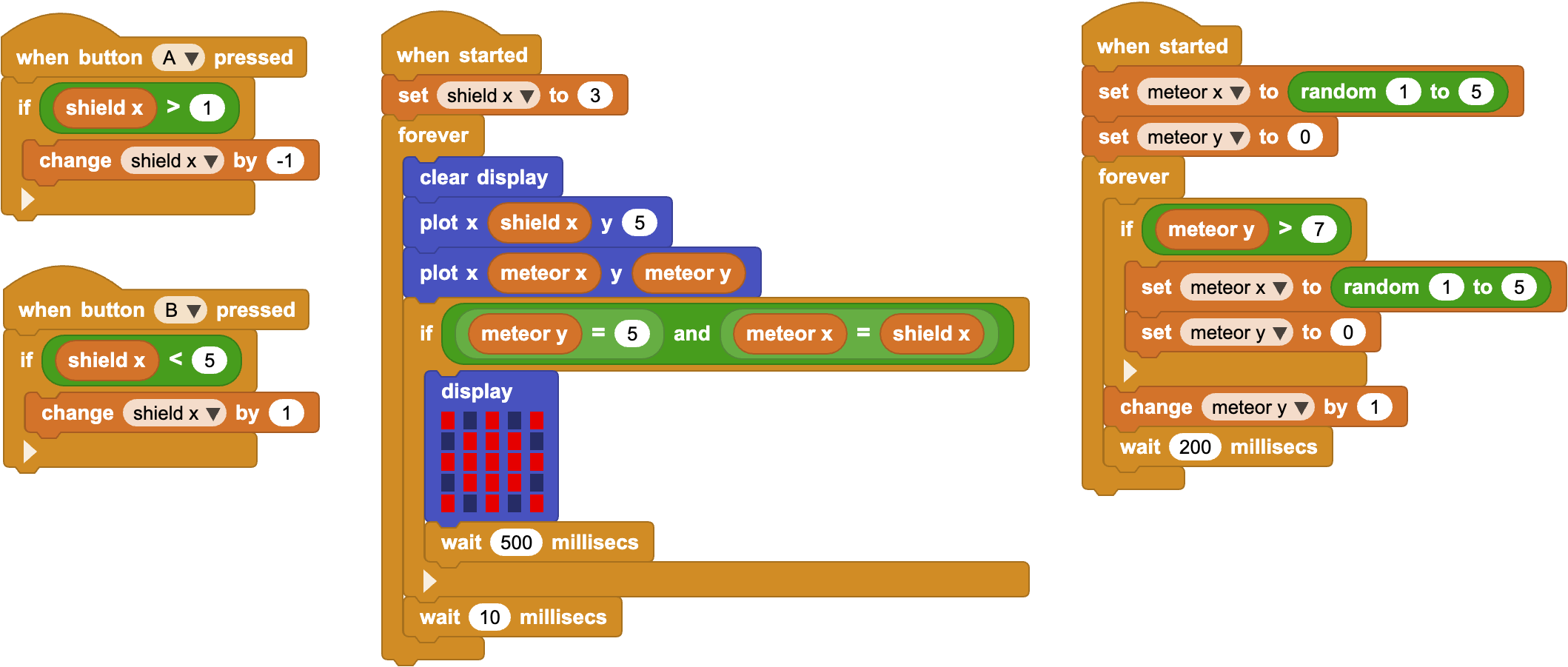
Here is the full game logic. You can drag this image right into MicroBlocks!
Teacher Notes
This project works well as:
- a review activity
- a game design lesson
- a creative extension project
- a group collaboration activity
Students are encouraged to:
- customize graphics
- change difficulty
- add sound effects
- modify gameplay
- create additional levels
Real-World Connection
Game development combines many areas of computer science, including:
- graphics
- logic
- timing
- interaction
- animation
- physics
- event handling
Even simple games use many of the same programming ideas found in professional game engines.